Skip to content
Dark mode:
  • COMCAR
  • PEMS
  • IPEA
  • PWSS
Ministerial and Parliamentary Services
Search

Search this site

Main navigation
  • About
    • About MaPS
    • Commonwealth Parliament Offices (MaPS state and territory offices)
    • Administration responsibilities
    • Responsibilities of parliamentarians, employees, MaPS and IPEA
    • Personal advice from IPEA
  • Pay and employment
    • Employment agreements and contracts
    • New employees
    • During employment
    • Ceasing employment
    • Employing a casual employee
    • Staff allowances
    • Salary packaging
    • Employment instruments and authorisations
    • Enterprise Agreement
    • Work Bases
    • Employee Consultative Group
    • Leave and public holidays
    • Pay cut-off dates
    • PEMS
  • Office management
    • Office manager responsibilities
    • Office management: property
    • Office types and purposes
    • Use of offices and office resources
    • Furniture, equipment and office ICT
    • Office maintenance
    • Refurbishments and relocations
    • Office expenses budget
    • PEMS
  • PBR framework & obligations
    • Parliamentary Business Resources framework
    • Parliamentary business (dominant purpose test)
    • Conditions for claiming
    • Value for money
    • Ethical obligations
    • Accountability
    • Referendum
  • Parliamentarians
    • Services to Ministers
    • Salary and remuneration: parliamentarians
    • Superannuation: parliamentarians
    • Fringe benefits tax
    • Exceptional circumstances determinations
    • Electorate allowance
    • Legal assistance to Ministers and Parliamentary Secretaries
    • Parliamentary Injury Compensation Scheme: parliamentarians
    • Insurance
    • Private plated vehicles: parliamentarians
    • Vehicle administration: parliamentarians
    • Residential internet and telephone costs
    • Resigning from the Parliament
  • Forms and resources
    • Circulars
    • Forms
    • Help guides
    • Important dates
    • Latest updates
    • Legislation
  • Contacts
  • COMCAR
  • PEMS
  • IPEA
  • PWSS
Menu
  • About
    • About
    • About MaPS
    • Commonwealth Parliament Offices (MaPS state and territory offices)
    • Administration responsibilities
    • Responsibilities of parliamentarians, employees, MaPS and IPEA
    • Personal advice from IPEA
  • Pay and employment
    • Pay and employment
    • Employment agreements and contracts
    • New employees
    • During employment
    • Ceasing employment
    • Employing a casual employee
    • Staff allowances
    • Salary packaging
    • Employment instruments and authorisations
    • Enterprise Agreement
    • Work Bases
    • Employee Consultative Group
    • Leave and public holidays
    • Pay cut-off dates
    • PEMS
  • Office management
    • Office management
    • Office manager responsibilities
    • Office management: property
    • Office types and purposes
    • Use of offices and office resources
    • Furniture, equipment and office ICT
    • Office maintenance
    • Refurbishments and relocations
    • Office expenses budget
    • PEMS
  • PBR framework & obligations
    • PBR framework & obligations
    • Parliamentary Business Resources framework
    • Parliamentary business (dominant purpose test)
    • Conditions for claiming
    • Value for money
    • Ethical obligations
    • Accountability
    • Referendum
  • Parliamentarians
    • Parliamentarians
    • Services to Ministers
    • Salary and remuneration: parliamentarians
    • Superannuation: parliamentarians
    • Fringe benefits tax
    • Exceptional circumstances determinations
    • Electorate allowance
    • Legal assistance to Ministers and Parliamentary Secretaries
    • Parliamentary Injury Compensation Scheme: parliamentarians
    • Insurance
    • Private plated vehicles: parliamentarians
    • Vehicle administration: parliamentarians
    • Residential internet and telephone costs
    • Resigning from the Parliament
  • Forms and resources
    • Forms and resources
    • Circulars
    • Forms
    • Help guides
    • Important dates
    • Latest updates
    • Legislation
  • Contacts
  • COMCAR
  • PEMS
  • IPEA
  • PWSS
Breadcrumb
  • Home
  • Forms and resources
  • Employing a non-ongoing employee
Forms

Employing a non-ongoing employee

This document should be used when engaging, or renewing, a non-ongoing employee under the Members of Parliament (Staff) Act 1984 (MOP(S) Act). Each agreement may cover a maximum period of 12 months. Upon expiry of the agreement, or promotion to a higher classification, a new agreement must be completed.

On this page

When to use this form
This document should be used when engaging, or renewing, a non-ongoing employee under the Members of Parliament (Staff) Act 1984 (MOP(S) Act). Each agreement may cover a maximum period of 12 months. Upon expiry of the agreement, or promotion to a higher classification, a new agreement must be completed.

What is non-ongoing employment?

A non-ongoing employee is employed for a specified period, and may be employed on a full-time or part-time basis. Non-ongoing employees are entitled to paid leave in accordance with the Commonwealth Members of Parliament Staff Enterprise Agreement 2024-27 (MOPS EA).

A non-ongoing employee may be engaged against an established position, or the Electorate Support Budget (ESB), or a combination of both.

Each period of engagement (the employment agreement) must not be for a period of:

    (a) more than 12 months against an established position, or

    (b) extend beyond the relevant financial year if employed against the Electorate Support Budget.

Limitations on non-ongoing employment under the Fair Work Act 2009

Changes to the Fair Work Act 2009 (FW Act) restrict the use of non-ongoing contracts beyond certain limits, and therefore all parliamentarians (and authorised officers) must be conscious of their use.

Specifically, changes to Section 333E of the FW Act state that non-ongoing contracts cannot be renewed:

  • beyond a maximum contracted period of 2 years; or
  • more than once (even if the total contracted period is less than 2 years).

Contract renewals must not be entered into with non-ongoing employees where they contravene these new provisions of the FW Act.
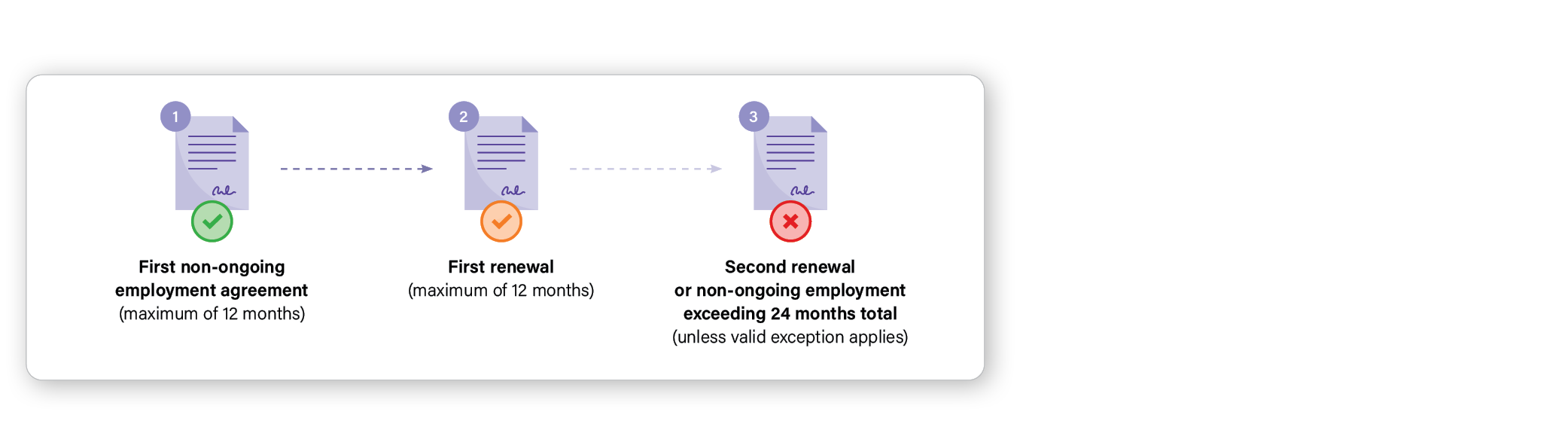
This is a flowchart graphic of the fixed-term contract limitations under the Fair Work Act. The flowchart shows the first non-ongoing contract with a tick, the second non-ongoing contract with a tick, and the third non-ongoing contract with a cross, to illustrate that a non-ongoing employee can only be renewed once unless an exception applies.

Exceptions to the FW Act limitations

There are some exceptions that apply which include:

  • If the engagement is to undertake work during a temporary absence of another employee. For example, a non-ongoing employee who is engaged to backfill a period of parental leave or long service leave; or
  • If the employee’s guaranteed earnings are over the high-income threshold in the year the contract is entered into.

If you think an exception applies, you are required to provide details in writing to the Parliamentary Workplace Support Service (PWSS) via HR@pwss.gov.au before an offer or renewal is made.

Onboarding a Non-Ongoing Employee – Additional Forms

The New Employees Tool can be used to determine which employment forms may be required, depending on the employee’s circumstances. Non-ongoing employees may be required to complete additional forms if:

  • this is their first employment agreement under the MOP(S) Act
  • it has been more than 12 months since they were last employed under the MOP(S) Act
  • any personal details have changed since the last period of employment (such as personal particulars, taxation or superannuation)
  • this period of MOP(S) Act employment is with a different parliamentarian from their last employment.

These additional forms must be completed by the employee and emailed separately to MOPSPayConditions@finance.gov.au.

Payroll Cut-Offs

Please submit all documents prior to the payroll cut-off to avoid any delays to payment or access to PEMS.

Late submission of any additional forms required can delay the processing of pay.

Further Assistance

FAQs clarifying the FW Act limitations are provided below.

If you have further questions after reviewing the FAQs, or would like assistance in determining how to implement the changes in your office, you can contact the Parliamentary Workplace Support Service (PWSS) HR Advice team on 1800 747 977 (option 2), or hr@pwss.gov.au.

FAQs regarding the FW Act limitations

When did the changes come into effect?

The FW Act amendment that limits the use of fixed term contracts came into effect on 6 December 2023 and applies to both personal and electorate non-ongoing employees employed under the MOP(S) Act.

Can I still renew a non-ongoing employee once?

Yes. A non-ongoing employee can be renewed once, before they reach the FW Act threshold.

Project scenario: Amy is employed as a non-ongoing staff member in an electorate office (EOB). Her non-ongoing contract is for 9 months to undertake a project. The project will take longer than expected due to the uncertainty of the timing of the election and the Parliamentarian wishes to renew Amy’s employment. Amy’s non-ongoing contract can be renewed once, but cannot exceed 2 years total non-ongoing employment. Amy receives a contract renewal for a further 6 months.

Can I still employ non-ongoing employees including against my Electorate Support Budget?

Yes, as long as the thresholds of the fixed-term provisions have not been reached, you can continue to employ non-ongoing employees either fully or partially against your ESB. Generally, you will be able to employ a non-ongoing employee for up to two years and renew their employment once.

Temporary capacity against the ESB scenario: Mike is employed as a non-ongoing staff member in an electorate office as an EOB. His non-ongoing contract is for 2 months to provide extra temporary capacity for the office during busy sitting periods, while other staff in the office travel with the Parliamentarian to Canberra. Mike is a good fit for the office, and the Parliamentarian renews Mike’s contract for another 2 months to continue the arrangement. At the end of the second contract, even though Mike has only worked 4 months in total, Mike’s non-ongoing employment is not able to be renewed as he has reached the threshold of the fixed term provisions. If the Parliamentarian wants to renew Mike’s employment again, Mike could be offered an ongoing role where one is available, or work on a casual basis.

What if my employee and I agree to end employment at the end of our existing agreement?

As long as the thresholds of the fixed-term provisions have not been met, the non-ongoing agreement can cease as usual.

Will my non-ongoing employees be eligible for severance at the election?

No. Non-ongoing employees are not eligible for severance. Per clause 73.1 of the MOP(S) Enterprise Agreement 2024-2027, only ongoing employees are eligible to receive severance in certain circumstances.

Does previous non-ongoing employment count towards the limitations?

Yes, previous non-ongoing employment (even with another parliamentarian) may be included when considering if the thresholds for fixed-term provisions have been met. The PWSS can assist with determining if previous non-ongoing employment will count toward the FW Act limitations.

What if there was a break in service between employment agreements?

Previous non-ongoing employment (even if there is a break in service) may be considered when determining if the thresholds for the fixed-term provisions have been met. The PWSS can assist with determining if it is considered a genuine break in service noting that section 333H of the FW Act prohibits certain actions being taken by an employer in order to avoid the application of the fixed-term provisions.

Can I prevent my employees from reaching the fixed term limits?

Section 333H of the FW Act outlines anti-avoidance provisions which prohibit employers from making changes to employment relationships in order to avoid the application of the provisions. For MOP(S) Act employees these include:

  • Terminating an employee’s employment for a period (i.e. forcing a break in service)
  • Delaying re-engaging the employee for a period
  • Not re-engaging an employee and instead engaging another person to perform the same or substantially similar work
  • Changing the nature of the work or tasks the employee is required to perform.

Civil penalties could apply if an employer is determined to have breached the anti-avoidance provisions.

Are there any exceptions to the limitations that apply?

There are some exceptions that apply under the FW Act which include:

  • If the engagement is to undertake work during the temporary absence of another employee. For example, a non-ongoing employee who is engaged to backfill a period of;
    • parental leave, or graduated return to work following parental leave
    • long service leave
    • extended personal leave
  • If the guaranteed earnings are over the high-income threshold in the year the contract is entered into.

If you think an exception applies, contact the PWSS. You are required to advise the PWSS in writing of any exception when you submit the non-ongoing agreement.

Backfilling scenario 1: Sam (EOB) goes on parental leave for 12 months. Mohammad (EOA) is placed on higher duties in Sam’s EOB position for 12 months. Laura is engaged on a non-ongoing basis as an EOA to backfill Mohammad’s position for an initial 12 months. Sam extends their leave for 6 months. Mohammad’s higher duties are subsequently extended for a further 6 months. Laura’s non-ongoing contract is renewed for 6 months. This arrangement is an exception from the provisions due to Laura being engaged to work during the temporary absence of another employee (subsection 333(F)(1)(d) of FW Act). Sam decides to extend their leave again for a further 6 months. Mohammad’s higher duties are subsequently extended for a further 6 months. Laura’s non-ongoing contract is renewed for another 6 months. Laura’s non-ongoing engagement continues to remain an exception from the FW Act provisions until Sam returns to their role. Sam then returns to work, and Mohammad returns to his EOA role. The office still has enough work to allocate Laura and would like to renew her employment again using their Electorate Support Budget. The office decides to employ Laura as a casual employee until the end of the Financial Year, to assist as required.
Backfilling scenario 2: Ting is a full-time employee, who goes on parental leave for 12 months. Hugh is engaged on a non-ongoing basis for an initial 12 months to backfill Ting’s leave. This arrangement is an exception from the provisions as it is a backfilling arrangement (subsection 333(F)(1)(d) of FW Act). Ting returns to work on an approved flexible work arrangement, for 2 days per week, and the remaining 3 days against her position are temporarily vacant. Following a conversation, the office and Hugh agree to renew Hugh’s non-ongoing agreement for an initial 6 months, at 3 days per week (filling the partial temporary vacancy). This arrangement is also an exception from the provisions, as Hugh is being engaged to work during the temporary absence of another employee (subsection 333(F)(1)(d) of FW Act), which includes a temporary absence resulting from an employee’s graduated return to work following parental leave.

What do I need to do if I regularly employ non-ongoing employees and believe I have staff that are impacted by these changes?

The PWSS will proactively be contacting offices to ensure appropriate arrangements are in place for those staff members impacted.

What do I need to do if I have a non-ongoing employee whose agreement is due to end shortly?

If it is your intention to renew the employee, the fixed-term provisions apply and may limit employment arrangements. This means you may not be able to employ the person as a non-ongoing employee. The PWSS can provide advice on employment options including the most appropriate type of employment for roles within your office.

What do I need to do if I have an employee who has been non-ongoing for more than two years?

You may not be able to employ the person as a non-ongoing employee. The PWSS can provide advice on employment options including the most appropriate type of employment for roles within your office.

What do I need to do if I have an employee who has had their non-ongoing agreement extended more than once?

You may not be able to employ the person as a non-ongoing employee. The PWSS can provide advice on employment options including the most appropriate type of employment for roles within your office.

What do I need to do if I need to make my employee ongoing, to comply with the FW Act changes, but don’t have a vacant position?

Contact the PWSS before you consider engaging or renewing a non-ongoing employee to ensure appropriate arrangements are in place for those staff members impacted.

What if my non-ongoing employee does not want to become ongoing?

If your employee does not wish to take up ongoing employment and they have already met the threshold of the fixed-term provisions, then the arrangement can be ceased at the employee’s request in writing. Any decision to alter an employment relationship in these circumstances should be well documented.

What do I do if my non-ongoing employee is not meeting my expectations and I had planned not to rehire them when their non-ongoing agreement ceased?

The PWSS can assist you with managing employment performance matters within your office.

Employment form

  • Current Employee details
  • Probation
  • Part time work pattern
  • Terms and conditions
  • Complete

When to use this form

This document should be used when you will be employed on a non-ongoing basis under the Members of Parliament (Staff) Act 1984 (the MOP(S) Act), or to renew your non-ongoing employment. 

Your employment may be full-time or part-time. 

Once a non-ongoing employment agreement is in place if there are any changes to your non-ongoing employment agreement, such as a change to your work-pattern or funding arrangement, use the Variation to an Existing Employment Agreement form.

Should your circumstances change and you are no longer able to complete the hours of work as indicated in this agreement please contact your employing Parliamentarian or Authorised Officer so they can advise MaPS at MOPSPayConditions@finance.gov.au.

Additional forms

You may be required to complete additional forms if this is the first time you are being employed under the MOP(S) Act, if you have had a break, or if this is a new office. Use the employment tool to identify which forms you should complete. Late or missing employment forms may delay your onboarding and pay.

Submission Requirements

Employment agreements are to be completed prior to, or on the date of, commencement.

  • Complete and submit the form online.
  • Your employer or authorised officer will receive a copy of the employment agreement via email. They must forward the agreement with their approval to MaPS for processing.
  • You will receive a copy of the agreement for your records.
Details

Details

An email will be sent to the employee for their records
An email will be sent to this email address to ensure details are correct and to authorise the contract.

Limitations to fixed term employment under the Fair Work Act 2009

Requests for non-ongoing contracts (including renewals or consecutive contracts) must be discussed with PWSS HR Advice before an offer is made and this form is completed.

Changes to the Fair Work Act 2009 (FW Act) restrict the use of non-ongoing contracts beyond certain limits. Specifically, non-ongoing contracts cannot be renewed beyond a maximum contracted period of 2 years, or, be renewed more than once (even if the total contracted period is less than 2 years).

Some exceptions apply, which include:

  • If the engagement is to undertake work during the temporary absence of another employee, for example to backfill a period of;
    • parental leave
    • long service leave
    • long term personal leave
  • If the employee’s guaranteed earnings are over the high-income threshold in the year the contract is entered into.
By proceeding, I confirm that I have discussed my non-ongoing employment with my employer, and that this employment agreement complies with the FW Act because (required)
Reason for exception
(a) the following date:

Start and End date difference can't be more than 12 months.

The end date has to be greater than the commence date.

(b) the date the employment is terminated, or;

(subject to maximum period of 12 months)

The maximum period of non-ongoing employment is 12 months (e.g. if commencing 15 January, the contract must end on or before 14 January the following year).

An end date must be included in option (a), even if the employment will end if the event in option (c) occurs.

Classifications

Funding arrangement

Funding arrangements against the Electorate Support Budget (ESB) cannot extend beyond the relevant financial year.

Non-ongoing employment against the ESB cannot extend beyond the relevant financial year. Employment which is wholly funded by the ESB and extends past 30 June will be processed with an automatic cessation date of 30 June (subject to the availability of sufficient funds).

Non-ongoing employment against the ESB cannot extend beyond the relevant financial year. Where an employment agreement is received with work days partially funded by the ESB and which extend past 30 June, these ESB-funded days will be processed with an amended cessation date of 30 June (subject to the availability of sufficient funds).

Indicate any full working days which will be funded using the ESB (and which will be processed up to a maximum end date of 30 June)

Other working pattern
(Advise of other periods of work to use the Electorate Support Budget, for example half days)
 

ESA should be allocated in consultation with the relevant guideline . This includes guidance on the level of ESA allocated to you within the suitable range of weekly additional hours (averaged over a 12 month period).

Are you a new nominated traveller for your office?

Are you a new nominated traveller for your office?

A completed nominated traveller form must be submitted to IPEA separately before this nomination is effective.

The Nominated Traveller is the electorate employee nominated in accordance with clause 5 of Determination 2023/10 - Staff Travel and Relief Staff Determination. Nominated Travellers receive 12 points of ESA as a Nominated Traveller Allowance (NTA) once the nominated traveller form has been completed and processed by IPEA . Nominated travellers may also receive additional points of ESA up to their individual 'cap' and subject to their parliamentarian's total ESA 'pool'.

Are you the current nominated traveller for your office?

Are you the current nominated traveller for your office?

The Nominated Traveller is the electorate employee nominated in accordance with clause 5 of Determination 2023/10 - Staff Travel and Relief Staff Determination. Nominated Travellers receive 12 points of ESA as a Nominated Traveller Allowance (NTA) *once the nominated traveller form has been completed and processed by IPEA . Nominated travellers may also receive additional points of ESA up to their individual 'cap' and subject to their parliamentarian's total ESA 'pool'

The Nominated Traveller is the electorate employee nominated in accordance with clause 5 of Determination 2023/10 - Staff Travel and Relief Staff Determination. Nominated Travellers receive 12 points of ESA as a Nominated Traveller Allowance (NTA) once the nominated traveller form has been completed and processed by IPEA . Nominated travellers may also receive additional points of ESA up to their individual 'cap' and subject to their parliamentarian's total ESA 'pool'.

*Please note that NTA + ESA 5 or ESA 6 is only available to certain individuals in accordance with clause 40.4(b) and 40.4(c) of the Commonwealth Members of Parliament Staff Enterprise Agreement 2024-27.

During your employment, the amount of ESA you are allocated by your Employer may change, including where there is an office re-allocation trigger under clause 41.5 of the Commonwealth Members of Parliament Staff Enterprise Agreement 2024-27.

*Please note that NTA + ESA 17 and ESA 18 may only be allocated to certain individuals in accordance with clause 40.4 (b) and 40.4 (c) of the Commonwealth Members of Parliament Staff Enterprise Agreement 2024-27.

During your employment, the amount of ESA you are allocated by your Employer may change, including where there is an office re-allocation trigger under clause 41.5 of the Commonwealth Members of Parliament Staff Enterprise Agreement 2020-23.

If ‘yes’, you must email a completed National Police History Check application to MOPSPay&Conditions@finance.gov.au.

For further information about this requirement click here
Pursuant to clause 73.6 I understand the effect of retaining a severance benefit on my entitlements.
I understand that I will be required to repay a portion of my severance benefit if I am re-employed during my severance pay period.
Previous employment

* Queensland parliamentary service is not considered MOP(S) Act equivalent prior service for the purposes of calculating the severance benefit, however may be recognised for personal and long service leave purposes in accordance with the Recognition of prior service guideline.

Should you wish to make a prior service request, please submit the Prior Service Kit.

Reference number
106
Type
Forms
Topics
MOPS Employment
  • MaPS privacy statement
  • Disclaimer
  • Accessibility
  • Copyright notice

MaPS acknowledges the Traditional Owners and Custodians throughout Australia and their continuing connection to land, water and community.

© Commonwealth of Australia 2026

ABN 61970 632 495

Back to top